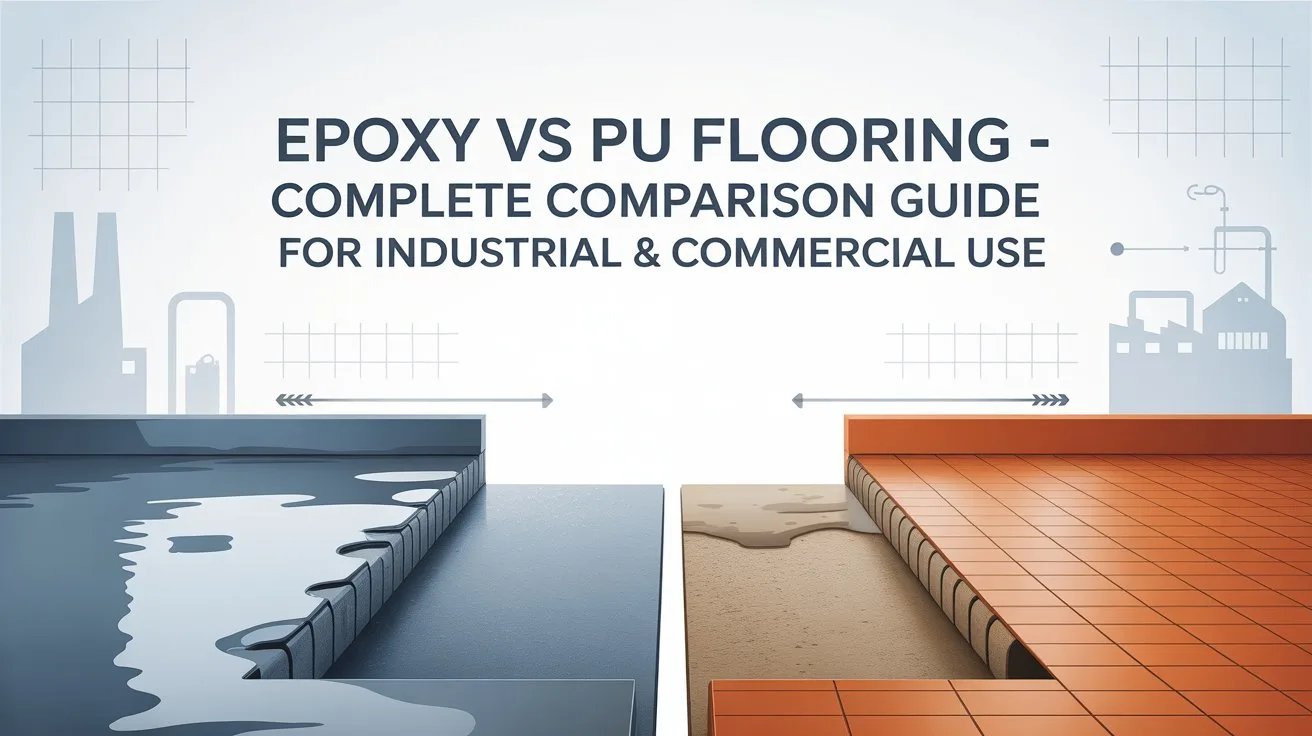
Epoxy and polyurethane flooring get compared on price more often than they get compared on what the floor will actually face day to day. That's backwards. The exposure conditions of a floor — thermal cycling, chemical contact, mechanical load, and hygiene requirements — should decide the system; price is what you optimise for once the right system is identified.
Epoxy is rigid, high-build, and excellent for compressive strength and chemical resistance in stable-temperature environments — warehouses, production floors, and light-to-medium industrial areas where the floor sees consistent conditions. It's also usually the more economical choice for large-format flooring where thick, seamless build is the priority.
Polyurethane is more flexible and handles thermal shock far better — think commercial kitchens, cold storage, and production areas with hot-water washdown, where the floor expands and contracts repeatedly. PU is also generally more resistant to organic acids, which makes it the standard choice in food and beverage processing. Where epoxy can crack or delaminate under repeated thermal cycling, PU flexes with the substrate.
Forklift and heavy wheeled traffic favour whichever system is specified at the correct thickness for the load — this is a build-thickness and substrate-preparation question as much as a resin-chemistry one. A 2mm epoxy screed under sustained forklift traffic will wear faster than the same resin at 4mm with a properly prepared substrate underneath it.
The practical approach: map out what the floor will actually be exposed to — temperature swings, chemical type and concentration, traffic type and frequency, and any hygiene or food-safety requirements — before choosing a resin family. Once that's settled, thickness, primer system, and finish (matte, satin, or high-gloss) are the variables that get tuned to budget.